Menu


Uganda Coffee
August 13, 2021 8 min read
Uganda Coffee: Arabica, Robusta, Growing Regions & Flavor
Coffee in Uganda is defined by remarkable diversity. Uganda grows both Arabica and Robusta coffee across regions that range from lower-elevation growing areas to high mountain slopes. Differences in elevation, climate, coffee species, processing, and roasting can create very different experiences in the cup.
For coffee drinkers, that means there is no single flavor that defines all Uganda coffee. Understanding where the coffee grows, how Arabica differs from Robusta, and how the coffee is processed and roasted gives you a much better idea of what makes coffee from Uganda distinctive.
Why Is Uganda an Important Coffee Growing Country?
Uganda is one of Africa's major coffee-producing countries, and coffee is deeply connected to the country's agricultural economy and farming communities.
The country grows both of the world's major commercial coffee species: Coffea arabica, commonly called Arabica, and Coffea canephora, commonly called Robusta. Robusta accounts for the majority of Uganda's coffee production, while Arabica is particularly associated with higher-elevation growing areas.
Uganda's coffee industry has also grown significantly. According to the Uganda Coffee Development Authority, the country exported a record 8.2 million 60-kilogram bags of coffee during the 12-month period reported in 2025.
For coffee drinkers, however, Uganda is much more interesting than a production statistic. Its combination of coffee species, mountainous growing areas, microclimates, processing methods, and regional differences gives the country a remarkably diverse coffee identity.
The History of Coffee in Uganda
Coffee has deep roots in Uganda, particularly Robusta, and has developed into one of the country's most important agricultural crops.
Commercial coffee production expanded considerably during the twentieth century. Coffee-planting campaigns in the 1950s helped national production reach approximately two million 60-kilogram bags by the early 1960s, according to Uganda's official coffee country profile.
Political and economic instability later disrupted coffee production, while changes in international coffee prices created additional challenges for farmers and exporters. Uganda's coffee sector eventually recovered and continued developing both its large Robusta industry and higher-elevation Arabica production.
Today, coffee in Uganda includes generations of farming knowledge, smallholder production, established Robusta-growing areas, mountain-grown Arabica, evolving processing methods, and increasing international interest in the distinct coffees produced across the country.
Where Is Coffee Grown in Uganda?
Coffee is grown across several regions of Uganda, and geography plays an important role in determining which coffee species thrives in a particular area.
Robusta is widely grown at lower elevations across Central, Eastern, Western, and Southeastern Uganda. Arabica is primarily associated with higher-elevation areas, including the slopes of Mount Elgon in eastern Uganda, the Rwenzori Mountains in the west, and mountainous areas of southwestern Uganda.
Elevation is only part of the story. Temperature, rainfall, soil, variety, farming practices, harvest, and processing all influence how a coffee develops and eventually tastes.
Mount Elgon Coffee
Mount Elgon in eastern Uganda is one of the country's best-known Arabica-growing areas.
The combination of high elevation, cooler temperatures, and volcanic soils provides conditions well suited to Arabica coffee. Uganda's official coffee profiles describe highland Arabica from these mountain regions as capable of showing complex combinations of floral, berry, citrus, chocolate, caramel, buttery, and nutty characteristics.
Mount Elgon is also closely associated with Bugisu Arabica, one of Uganda's established coffee identities.
The important thing for a coffee drinker to understand is that even within Mount Elgon, the final cup is influenced by much more than geography. Variety, harvest, processing, and roasting all play a part.
Rwenzori Coffee
The Rwenzori Mountains in western Uganda are another important Arabica-growing area.
Coffee grown on the mountain slopes can be processed using different methods, and those choices can create noticeable differences in the finished cup. Uganda's regional coffee profiles distinguish between naturally processed and washed Rwenzori coffees, illustrating just how much processing can influence mouthfeel, acidity, aroma, and flavor.
This is one reason it is misleading to think of Uganda coffee as a single flavor profile. Two coffees can come from the same country—or even the same broader growing region—and still taste very different.
Other Coffee-Growing Regions in Uganda
Uganda's coffee landscape extends well beyond Mount Elgon and the Rwenzori Mountains.
Arabica is also grown in other highland areas, including parts of southwestern and northwestern Uganda, while Robusta production extends across large lower-elevation areas of the country.
It is more useful to think of Uganda as a collection of coffee-growing environments than as one uniform origin. Those different environments help create the diversity found in Ugandan coffee.
Arabica vs. Robusta Coffee in Uganda
Uganda grows both Arabica and Robusta coffee, but the two species differ in where they tend to grow and in the characteristics they can produce in the cup.
Understanding both is essential to understanding coffee in Uganda.
Arabica Coffee in Uganda
Ugandan Arabica is primarily associated with higher-elevation growing areas.
Important Arabica regions include the slopes of Mount Elgon, the Rwenzori Mountains, and mountainous areas of southwestern Uganda. Cooler conditions at higher elevations can allow coffee cherries to develop differently from coffee grown in warmer, lower areas.
Depending on region, variety, processing, and roasting, Ugandan Arabica can offer combinations of fruit, citrus, chocolate, sweetness, acidity, floral qualities, and varying levels of body. But origin alone never determines flavor.
A washed Arabica and a naturally processed Arabica from Uganda may share the same country of origin while delivering noticeably different experiences in the cup.
Robusta Coffee in Uganda
Robusta is central to Uganda's coffee identity and accounts for the majority of the country's coffee production.
It is generally grown at lower elevations than Arabica and is well adapted to many of Uganda's warmer coffee-growing areas. Robusta also differs from Arabica in plant characteristics, chemistry, body, and flavor.
It is overly simplistic to describe Arabica as "good coffee" and Robusta as "bad coffee." Quality depends on much more than species. Genetics, growing conditions, harvesting, processing, storage, roasting, and brewing all affect the final cup.
Uganda's own sensory research shows meaningful differences among Robusta coffees grown in different agro-ecological zones, just as regional differences appear among its Arabica coffees.
For anyone interested in coffee from Uganda, understanding the importance of both species provides a much more complete picture of the country's coffee culture.
How Is Coffee Grown and Produced in Uganda?
Coffee production in Uganda begins long before green coffee reaches a roaster.
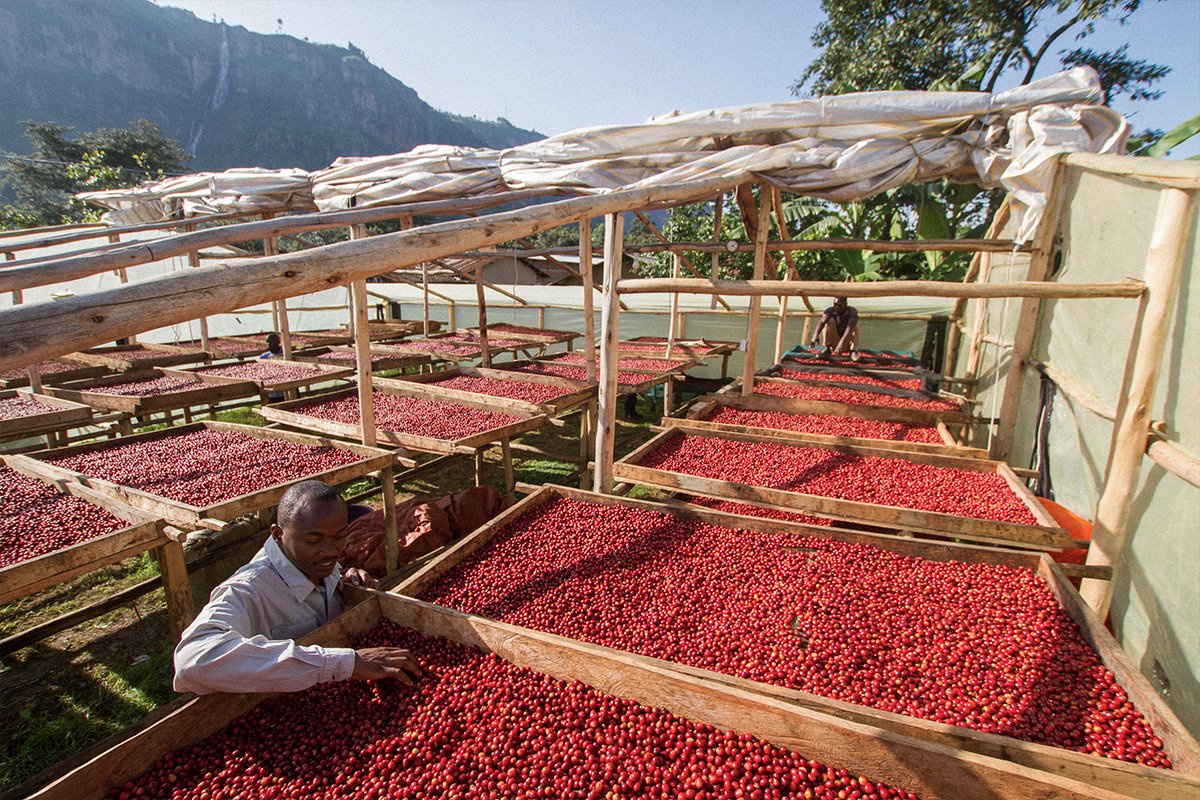
Farmers establish and maintain coffee trees, manage the growing environment, and harvest coffee cherries when they reach the appropriate stage of ripeness. After harvesting, the cherries must be processed and carefully dried before the coffee is prepared for storage, grading, sale, and export.
Growing conditions differ significantly across the country.
Robusta is generally associated with Uganda's warmer, lower-elevation coffee areas, while Arabica is primarily grown in higher mountain environments. These differences in elevation and climate affect how coffee trees and cherries develop.
After harvest, processing adds another important layer of differentiation.
How Is Uganda Coffee Processed?
Coffee in Uganda is processed using both wet and dry methods.
In wet processing, the fruit is removed from the coffee, the coffee is washed, and the parchment coffee is dried before further preparation.
Dry processing takes a different approach: the coffee cherries are dried before the dried outer layers are removed.
Uganda's coffee authorities note that wet processing is used for selected high-altitude Arabica coffees, including coffees from Mount Elgon and other mountainous growing areas, while dry processing has traditionally played an important role in Robusta production.
Why does that matter to someone drinking the coffee?
Because processing can influence aroma, sweetness, fruit character, acidity, body, and mouthfeel. It is another reason two coffees from Uganda can taste completely different even when "Uganda" appears on both bags.
What Does Uganda Coffee Taste Like?
There is no single flavor profile for Uganda coffee.
Coffee flavor is influenced by species, variety, growing region, elevation, climate, harvest, processing, storage, roasting, and brewing. Uganda's diversity across those factors produces a wide range of sensory experiences.
Research from Uganda's coffee authorities found regional differences across more than 1,000 coffee samples collected from the country's coffee-growing areas. Ugandan Arabica profiles included characteristics associated with dried fruit, citrus, chocolate, spice, herbs, acidity, and body, while Robusta profiles included combinations of caramel, nuts, tropical fruit, spice, herbs, and dried fruit.
Those are broad characteristics across many coffees, not a promise that every Uganda coffee will taste the same. However, once green coffee reaches a roaster, another transformation begins.
How Roasting Shapes Coffee from Uganda
Green coffee gives a roaster the starting point. The job of roasting is to develop what is already there into a balanced and satisfying cup.
At Weaver's Coffee & Tea, we don't believe a coffee should be roasted according to a formula simply because it comes from a particular country. The individual green coffee matters.
A roaster has to consider sweetness, acidity, body, balance, development, and how those characteristics work together. Roast too aggressively and you can overwhelm some of the distinctions that made the coffee interesting. Develop the coffee poorly and the cup may lack the sweetness, structure, and balance you were looking for.
This is especially important with an origin as diverse as Uganda.
"Uganda" tells us where the coffee comes from. It doesn't tell us everything the coffee needs. The coffee itself still has to be roasted and tasted.
How to Brew Uganda Coffee
There is no single brewing method required for coffee from Uganda.
The best method depends on the individual coffee, roast profile, grind, water, and the type of cup you enjoy.
Pour-over can be a good choice when you want to explore clarity and individual flavor characteristics. French press can emphasize body and texture. Automatic drip is practical for a balanced everyday cup, while some Ugandan coffees can also work beautifully as espresso when the coffee and roast are suited to that brewing method.
Whatever method you choose, use the appropriate grind size for your brewer and adjust your recipe based on taste.
If the cup tastes thin or sharply sour, extraction may need adjustment. If it tastes harsh, overly bitter, or drying, look at grind size, water temperature, brew time, and coffee-to-water ratio.
Good brewing should help you taste the coffee, not fight against it.
Taste Uganda Coffee from Weaver's
Learning about coffee in Uganda is fascinating. Tasting it brings the origin to life.
Weaver's Uganda Coffee is a single-origin Arabica coffee roasted to a smooth medium profile. In this particular coffee, our tasting notes include ripe cherry, cocoa, mild citrus, balanced acidity, a smooth body, and a buttery finish.
Those tasting notes describe Weaver's Uganda Coffee, not every coffee grown in Uganda.
Our Uganda Coffee can be brewed as pour-over, French press, drip coffee, or espresso depending on the style of cup you prefer.
Explore Weaver's Uganda Coffee
Explore African Coffee Origins
Uganda is one part of an extraordinary African coffee landscape.
Coffees from Uganda, Kenya, Rwanda, Ethiopia, and other African origins can differ dramatically in variety, elevation, processing, flavor, and roasting approach. Exploring coffees from different origins side by side is one of the best ways to understand how much the place where coffee grows can influence what ultimately reaches your cup.
If you enjoy discovering coffee through origin, explore Weaver's Single Origin Coffees and our guides to coffee-growing regions around the world.
Frequently Asked Questions About Coffee in Uganda
Is coffee grown in Uganda?
Yes. Uganda is a major African coffee-growing country and produces both Arabica and Robusta coffee. Robusta is widely grown in lower-elevation areas, while Arabica is particularly associated with higher-elevation mountain regions.
Does Uganda grow Arabica or Robusta coffee?
Uganda grows both Arabica and Robusta. Robusta accounts for the majority of the country's coffee production, while Arabica is grown primarily in higher-altitude regions such as Mount Elgon, the Rwenzori Mountains, and parts of southwestern Uganda.
Where is coffee grown in Uganda?
Coffee is grown across several regions of Uganda. Important Arabica-growing areas include Mount Elgon and the Rwenzori Mountains, while Robusta is widely cultivated across lower-elevation coffee-growing areas in Central, Eastern, Western, and Southeastern Uganda.
What does Uganda coffee taste like?
Uganda coffee does not have one universal flavor profile. Flavor varies according to coffee species, growing region, elevation, variety, processing, harvest, roasting, and brewing. Depending on the coffee, Ugandan coffees can show characteristics including fruit, citrus, chocolate, caramel, spice, sweetness, acidity, and varying levels of body.
Is Uganda known for coffee?
Yes. Uganda is a major coffee producer and exporter with a particularly important Robusta industry as well as high-elevation Arabica production. Coffee is also an important part of the country's agricultural economy.
Subscribe
Sign up to get the latest on sales, new releases and more …